
Exercise Trishul: India’s Spear of Readiness Showcasing the Lethal Edge of the Indian Armed Forces
MILITARY EXERCISE
The Indian Armed Forces regularly conduct large-scale military exercises to test preparedness, sharpen combat skills, and demonstrate deterrence against emerging threats.
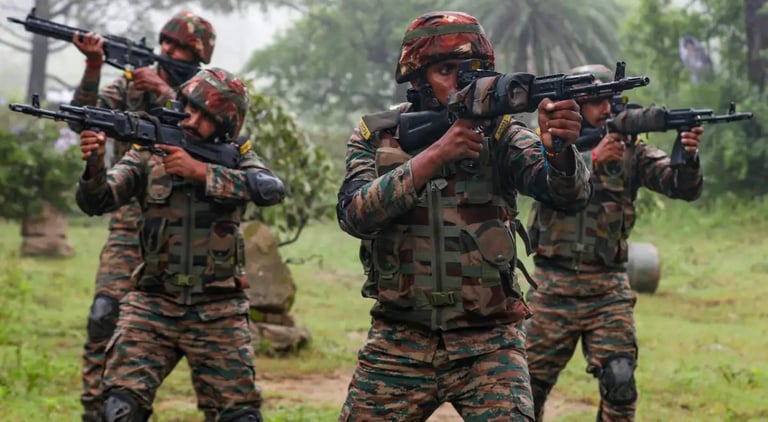
Among these, Exercise Trishul stands out as a powerful symbol of India’s operational readiness and joint-force coordination. Named after the mythological weapon symbolising precision and destruction, Exercise Trishul reflects the Indian military’s evolving doctrine of swift, decisive, and technology-driven warfare.
Purpose and Strategic Significance
Exercise Trishul is primarily designed to validate the Indian Army’s combat readiness under realistic battlefield conditions. The exercise focuses on offensive and defensive operations, rapid mobilisation of troops, and effective use of modern weapon systems. Conducted in strategically sensitive regions—often near deserts, plains, or semi-arid terrains—it simulates conditions that Indian forces may face during real-world contingencies.
The broader objective is to ensure that formations can transition seamlessly from peacetime to wartime posture. It tests command-and-control structures, battlefield decision-making, and the ability to execute missions under intense operational pressure. For India, surrounded by complex security challenges on both western and northern fronts, exercises like Trishul are critical for maintaining a credible deterrent.
Realistic Battlefield Scenarios
One of the defining features of Exercise Trishul is its emphasis on realistic warfighting scenarios. Troops operate in near-combat conditions, including day-and-night manoeuvres, rapid advances, defensive holds, and counter-attacks. These scenarios are crafted to reflect modern threats such as swift armoured thrusts, precision artillery strikes, and coordinated infantry assaults.
The exercise often involves the use of live ammunition, which significantly enhances realism and allows commanders to assess the effectiveness of tactics and weapon systems. From infantry units engaging simulated enemy positions to armoured columns advancing under artillery cover, every aspect of battlefield dynamics is put to the test.
Integration of Modern Weapon Systems
Exercise Trishul highlights the Indian Army’s increasing reliance on modern and indigenous defence technology. Advanced artillery systems, armoured fighting vehicles, surveillance drones, and battlefield communication networks are integrated into operations. The exercise also showcases India’s progress in network-centric warfare, where real-time data sharing between units improves situational awareness and response time.
Artillery regiments play a crucial role, demonstrating their ability to deliver accurate and sustained firepower. Mechanised infantry and armoured units work in close coordination, reflecting the Army’s focus on mobility, speed, and firepower. Such integration ensures that Indian forces can respond rapidly to evolving threats while minimising casualties.
Jointness and Inter-Arm Coordination
While Exercise Trishul is primarily Army-centric, it underscores the growing emphasis on jointness within the Indian Armed Forces. Coordination between infantry, armour, artillery, engineers, and logistics units is rigorously tested. Air assets, including helicopters and surveillance platforms, are often used to support ground operations, reinforcing the importance of air-ground synergy.
This inter-arm coordination is essential for modern warfare, where success depends not on isolated units but on the seamless functioning of multiple combat and support elements. Exercise Trishul serves as a proving ground for commanders to refine coordination mechanisms and improve interoperability across formations.
Training Leadership and Decision-Making
Beyond firepower and manoeuvres, Exercise Trishul is also a test of leadership under pressure. Senior commanders and junior officers alike are required to make rapid decisions based on dynamic battlefield conditions. The exercise evaluates command efficiency, adaptability, and the ability to exploit opportunities while mitigating risks.
Such training is vital for nurturing future military leaders. By exposing officers to complex and high-stress scenarios, the Indian Army ensures that its leadership remains capable of handling real-world conflicts with clarity and confidence.
Message of Deterrence and Preparedness
Exercises like Trishul send a clear message—India’s Armed Forces remain vigilant, capable, and prepared to defend national sovereignty. While the exercise is not directed at any specific adversary, its timing and scale often carry strategic signalling value. It reassures the nation and signals to external observers that India possesses the operational capability to respond decisively to any challenge.
At the same time, Exercise Trishul reflects India’s commitment to peace through strength. By maintaining a high level of readiness, the Indian Armed Forces aim to deter conflict rather than provoke it.
Continuous Evolution and Lessons Learned
Each iteration of Exercise Trishul builds upon lessons learned from previous drills. Feedback from troops and commanders is used to refine tactics, improve training methodologies, and upgrade operational doctrines. This continuous learning process ensures that the Indian Army evolves alongside emerging technologies and changing threat perceptions.
As warfare becomes increasingly complex—incorporating cyber, space, and electronic dimensions—exercises like Trishul will continue to adapt, integrating new domains into traditional land operations.
Conclusion
Exercise Trishul is more than a routine military drill; it is a comprehensive demonstration of India’s combat readiness, technological progress, and leadership strength. By combining realistic scenarios, modern weaponry, and joint-force coordination, the exercise ensures that the Indian Armed Forces remain sharp, agile, and prepared for the challenges of tomorrow. In an uncertain global security environment, Exercise Trishul stands as a testament to India’s unwavering commitment to national defence and operational excellence.
Recommended Reads:
Follow us
DISCLAIMER
© 2025 Defence Insider. All rights reserved.