
Ladakh Standoff Book Sparks Political Face-Off Between Rahul Gandhi and Rajnath Singh
INDIAN DEFENCE
The long-simmering political debate over the 2020 Ladakh standoff between Indian and Chinese troops has resurfaced with renewed intensity, following the publication of a book by a former Army Chief.
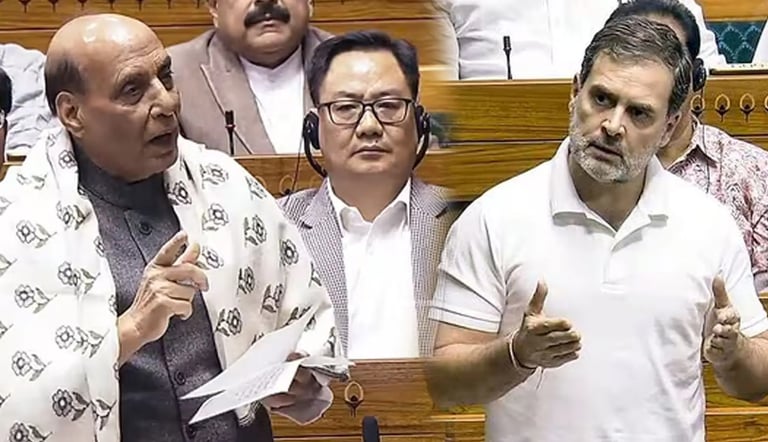
The book’s references to ground realities, military preparedness, and decision-making during the crisis have triggered a sharp political exchange between Congress leader Rahul Gandhi and Defence Minister Rajnath Singh, once again placing national security at the centre of partisan confrontation.
The Ladakh standoff, which escalated dramatically after the deadly clash in the Galwan Valley in June 2020, remains one of the most sensitive chapters in India’s recent strategic history. While the government has repeatedly asserted that India’s territorial integrity was not compromised, opposition leaders have consistently questioned the official narrative. The former Army Chief’s book, without directly naming political leaders, offers reflections that many interpret as challenging certain government claims, thereby reigniting political tensions.
Rahul Gandhi’s Attack on the Government
Rahul Gandhi was quick to seize upon the book’s observations, using them to renew his criticism of the Bharatiya Janata Party (BJP)-led government. He argued that the book vindicates the opposition’s long-held position that the truth about Chinese incursions in Ladakh has not been fully disclosed to the public. According to Gandhi, national security cannot be safeguarded through “denial and silence,” and honest accountability is essential in a democracy.
The Congress leader accused the government of undermining transparency on an issue of grave national importance. He also reiterated his demand for a clear explanation of how and why the situation in eastern Ladakh escalated, and what lessons have been learned to prevent similar confrontations in the future. Gandhi framed the issue not as a political attack, but as a question of national interest, stating that the armed forces deserve clarity, honesty, and institutional support rather than political defensiveness.
Rajnath Singh’s Strong Rebuttal
Defence Minister Rajnath Singh responded firmly, dismissing the opposition’s claims as irresponsible and misleading. He emphasized that selective interpretation of a book written in a personal capacity should not be used to cast doubt on the professionalism of the armed forces or the government’s handling of the situation. Singh reaffirmed that the Indian Army remains fully capable of defending the country’s borders and that necessary steps were taken during and after the standoff to strengthen India’s strategic position in Ladakh.
Singh also cautioned against politicizing military matters, arguing that such debates could harm morale and provide fodder to adversaries. He stressed that the government works closely with the armed forces and that strategic decisions are taken after careful assessment, not political pressure. According to him, the opposition’s statements risk creating confusion and mistrust among citizens regarding national security.
The Role of the Former Army Chief’s Book
At the heart of the controversy lies the former Army Chief’s account, which reflects on operational challenges, intelligence assessments, and the evolving nature of modern border conflicts. While the book does not explicitly accuse the government of failure, its candid tone has opened space for political interpretation. Supporters of the government argue that memoirs are subjective and should be read in context, whereas critics see the book as a rare insider perspective that questions the official narrative.
Military veterans and strategic analysts have offered mixed reactions. Some believe the book contributes constructively to public understanding of complex security issues, while others worry that politicization of such accounts could discourage future military leaders from sharing honest assessments. The debate highlights the delicate balance between transparency, accountability, and national security.
Broader Political Implications
The renewed face-off comes at a time when national security is a key electoral issue. For the BJP, projecting strength on defence and border management is central to its political messaging. For the Congress, questioning the government’s handling of Ladakh aligns with its broader critique of governance, transparency, and institutional accountability.
This episode also underscores how defence matters increasingly intersect with political discourse in India. While democratic debate is essential, repeated confrontations over sensitive military issues raise questions about where the line should be drawn between accountability and politicization.
Conclusion
The controversy surrounding the Ladakh standoff book and the ensuing clash between Rahul Gandhi and Rajnath Singh reflects deeper tensions in India’s political landscape. It is not merely a disagreement over a book, but a broader struggle over narrative, trust, and responsibility in matters of national security. As India continues to face complex border challenges, the debate highlights the need for informed discussion that respects democratic scrutiny while safeguarding strategic interests.
Whether the political storm will lead to greater transparency or fade into another episode of partisan conflict remains to be seen. What is clear, however, is that the Ladakh standoff continues to shape India’s political and strategic discourse long after troops disengaged on the icy heights of the Himalayas.
Recommended Reads:
Follow us
DISCLAIMER
© 2025 Defence Insider. All rights reserved.