
Mother of All Deals: India–EU Agreement Poised to Reshape 2026 Trade Dynamics
INDIAN DEFENCEGLOBAL DEFENCE
The proposed India–European Union (EU) trade agreement, expected to reach a decisive stage by 2026, is being widely described as the “Mother of All Deals” — and not without reason.
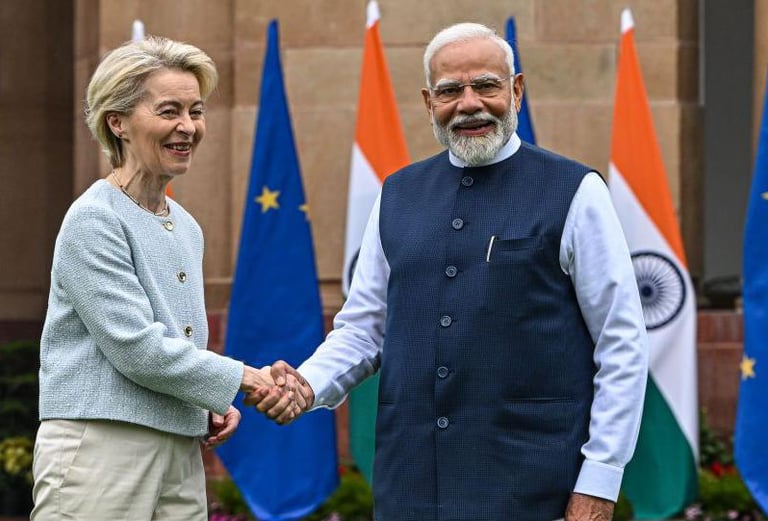
Covering two of the world’s largest economic blocs, this agreement has the potential to reshape global trade patterns, strategic alliances, and geopolitical equations for decades to come. More than just a conventional free trade agreement (FTA), the India–EU deal represents a convergence of economic ambition, strategic necessity, and political recalibration in a rapidly changing world order.
A Deal Years in the Making
Negotiations between India and the EU began over a decade ago but faced repeated deadlocks over tariffs, market access, regulatory standards, and mobility of professionals. However, the post-pandemic economic reset, rising geopolitical tensions, and the global push for supply chain diversification have breathed new life into the talks. Both sides now see the agreement not merely as a trade pact, but as a strategic partnership aligned with long-term interests.
The EU is India’s largest trading partner, while India represents one of the fastest-growing major economies globally. By 2026, policymakers aim to finalize a comprehensive agreement that includes trade in goods and services, investment protection, digital trade, intellectual property, sustainability standards, and defense-industrial cooperation.
Economic Scale and Strategic Impact
If concluded, the India–EU agreement would link markets representing over a quarter of global GDP and nearly 2 billion people. For India, the deal offers greater access to high-value European markets for pharmaceuticals, textiles, automotive components, IT services, and renewable energy technologies. For the EU, India provides a massive consumer base, a manufacturing hub, and a democratic counterweight in the Indo-Pacific region.
Unlike earlier FTAs, this deal is expected to go beyond tariff reductions. It aims to harmonize standards, streamline regulations, and enable smoother cross-border investments. This could significantly reduce transaction costs for businesses and attract long-term European capital into India’s infrastructure, green energy, and advanced manufacturing sectors.
Supply Chains, China, and Global Realignment
One of the most important drivers behind the deal is the global shift away from overdependence on China. Both India and the EU are actively seeking resilient, diversified supply chains. The agreement could position India as a preferred manufacturing and logistics partner for European companies looking to de-risk their operations.
In strategic terms, this alignment sends a strong signal. It reflects a shared commitment to rules-based trade, democratic values, and economic sovereignty. While the agreement is not explicitly anti-China, its implications for global trade balance and strategic autonomy are unmistakable.
Digital Trade and Technology Cooperation
Digital trade is expected to be a cornerstone of the agreement. India’s rapidly expanding digital economy — spanning fintech, e-commerce, AI, and data services — aligns well with Europe’s advanced regulatory frameworks and technological expertise. Negotiators are working to balance data protection concerns with the need for seamless digital flows.
Technology transfer, cybersecurity cooperation, and innovation partnerships are likely to feature prominently. This could strengthen India’s position in emerging technologies while allowing European firms to tap into India’s talent pool and startup ecosystem.
Sustainability and Climate Commitments
Sustainability is another defining feature of the proposed deal. The EU has been vocal about integrating environmental and labor standards into trade agreements. India, while cautious about restrictive clauses, recognizes the opportunity to leverage green finance, clean technology, and climate partnerships.
The agreement may include provisions related to carbon markets, renewable energy collaboration, electric mobility, and sustainable supply chains. If managed carefully, this could accelerate India’s green transition while aligning with Europe’s climate goals.
Defense, Security, and Strategic Trust
Beyond economics, the deal carries strategic and defense implications. India and the EU have been expanding cooperation in maritime security, defense manufacturing, and strategic dialogue. A strong economic foundation would further enhance trust and open avenues for joint defense production, technology sharing, and industrial collaboration.
For India, this supports the broader “Make in India” and “Atmanirbhar Bharat” objectives. For Europe, it offers a reliable partner in a region of growing strategic importance.
Challenges and the Road Ahead
Despite optimism, challenges remain. Differences over agricultural tariffs, intellectual property rights, labor mobility, and regulatory standards could still slow progress. Domestic political considerations on both sides will also play a role as negotiations move closer to conclusion.
However, the renewed momentum suggests a willingness to compromise and innovate. The focus is shifting from narrow sectoral interests to long-term strategic gains.
Why It Truly Is the “Mother of All Deals”
What sets the India–EU agreement apart is its scale, scope, and timing. It is not just about trade volumes or tariff lines; it is about shaping the future architecture of global commerce and strategic partnerships. In an era marked by fragmentation, protectionism, and geopolitical uncertainty, this deal represents a rare opportunity for constructive, forward-looking cooperation.
If finalized by 2026, the India–EU agreement could redefine how major democracies collaborate economically and strategically — making it, quite fittingly, the Mother of All Deals.
Recommended Reads:
Follow us
DISCLAIMER
© 2025 Defence Insider. All rights reserved.