
One Family, One Party? Inside Congress’ Leadership Crisis and the Gandhi Dominance Debate
ARTICLE
For decades, the Indian National Congress has been synonymous with one surname—the Gandhis. From Jawaharlal Nehru to Indira Gandhi, Rajiv Gandhi, Sonia Gandhi, Rahul Gandhi, and now Priyanka Gandhi Vadra, the party’s top leadership has remained firmly within the same family.
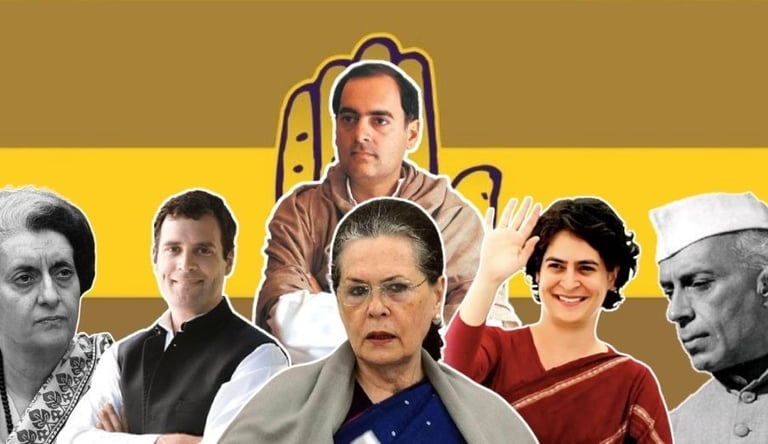
What once symbolized continuity and legacy has increasingly become the centre of a fierce national debate: is Congress overly dependent on the Gandhi family, and has this dependence weakened internal democracy within the party?
This question isn’t just raised by political rivals. It echoes within Congress itself—among senior leaders, grassroots workers, and even loyal supporters who worry about the party’s future relevance.
The Legacy Advantage—and Its Limits
There is no denying the historical weight the Gandhi family carries. The name evokes India’s freedom struggle, institution-building, and decades of governance. For many Congress supporters, the Gandhis provide a unifying emotional anchor in a party otherwise fractured by ideology, region, and ambition.
However, legacy alone cannot substitute leadership performance in modern electoral politics. Over the past decade, Congress has faced repeated defeats in national and state elections. Each loss has intensified scrutiny over whether the party’s leadership structure—centered almost entirely around one family—has become a liability rather than an asset.
Rahul Gandhi: Leader by Lineage or Merit?
Rahul Gandhi’s leadership has been one of the most debated subjects in Indian politics. Supporters argue that he represents sincerity, ideological clarity, and a willingness to challenge entrenched power structures. Critics, however, question his political instincts, communication strategy, and ability to convert narratives into electoral victories.
The core issue isn’t whether Rahul Gandhi is capable or not—it’s how he became the default leader. In most democratic political parties, leadership emerges through competition, internal elections, or demonstrable mass appeal. In Congress, leadership transitions have often appeared pre-decided, reinforcing the perception that lineage outweighs merit.
Internal Democracy: Symbolic or Substantial?
Congress officially prides itself on being a democratic organization. Internal elections are held, committees are formed, and resolutions are passed. Yet, many party insiders claim these processes are largely symbolic.
Key decisions—candidate selection, alliance negotiations, leadership appointments—are believed to be influenced or finalized by the high command, which revolves around the Gandhi family and a small inner circle. This structure discourages independent leadership growth and sidelines strong regional leaders who do not align closely with the central leadership.
Several prominent leaders have left Congress over the years, citing frustration with this culture. Their exits have further fueled the argument that the party struggles to accommodate ambition unless it flows upward toward the Gandhis.
The Cost of Centralization
Excessive centralization has real political consequences. State units often feel disconnected from the national leadership, leading to poor coordination during elections. Local leaders, who understand regional realities better, frequently complain that decisions are imposed from Delhi without adequate consultation.
This disconnect has cost Congress winnable battles. In states where strong regional leadership could have anchored revival, internal conflicts and delayed decisions have weakened the party’s position, allowing rivals to fill the vacuum.
Fear of a Leadership Vacuum
Ironically, even critics within Congress hesitate to openly challenge the Gandhi family. The reason is simple: fear of chaos. Many believe that without the Gandhis, the party could fragment further, with factions pulling in different directions.
This creates a paradox. The Gandhi family is seen as both the problem and the glue holding Congress together. As a result, reform remains cautious, incremental, and often cosmetic.
Youth Appeal and the Changing Political Landscape
India’s electorate is young, aspirational, and increasingly performance-driven. Political loyalty based purely on legacy is fading. Parties that project decisive leadership, clarity of vision, and organizational discipline are gaining ground.
Congress’s inability to project a clear alternative leadership model—beyond the Gandhis—hurts its appeal among young voters. While Rahul Gandhi’s outreach efforts and mass campaigns have improved visibility, they have not yet translated into consistent electoral momentum.
Can Congress Break the Cycle?
The real question is not whether the Gandhi family should exit politics, but whether Congress can institutionalize leadership beyond one family. This would require genuine internal elections, empowerment of state leaders, tolerance of dissent, and a clear succession framework not tied to lineage.
Such reform is risky, but without it, Congress risks becoming a party trapped in nostalgia—remembered for what it once was, not for what it can become.
Conclusion: A Moment of Truth
The debate over Gandhi family dominance is ultimately a debate about Congress’s survival. In a rapidly evolving political environment, emotional legacy must be matched with organizational reform. If Congress can balance respect for its past with courage for change, it may yet reinvent itself.
If not, the leadership crisis will persist—and with it, the uncomfortable question that refuses to go away: can a party that once led India’s freedom struggle free itself from its own family shadow?
Recommended Reads:
Follow us
DISCLAIMER
© 2025 Defence Insider. All rights reserved.