
Supreme Court Halts UGC Equity Regulations Over Inclusion Concerns
INDIAN DEFENCE
The Supreme Court’s decision to put a stay on the University Grants Commission’s Equity Regulations 2026 has sparked a nationwide debate on inclusion, fairness, and the future of India’s higher education system.
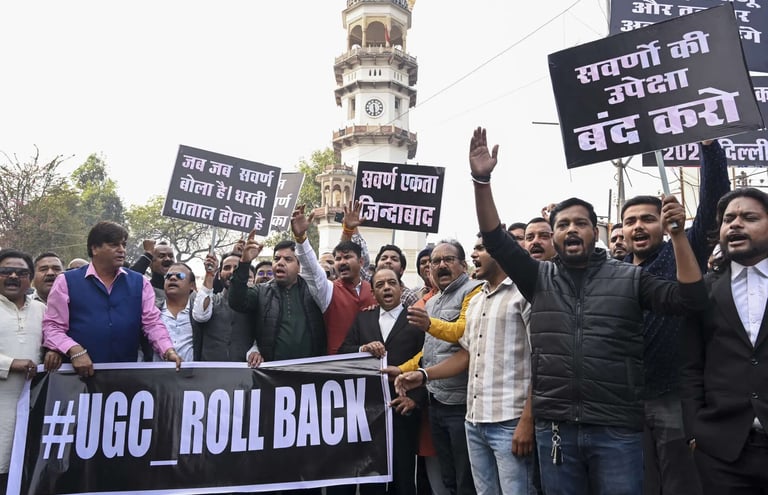
The apex court’s intervention comes amid growing concerns that the new rules, instead of promoting equality, may unintentionally create exclusion and imbalance within academic institutions.
The UGC Equity Regulations 2026 were introduced with the stated aim of preventing discrimination and ensuring equitable treatment of students and faculty across universities and colleges. The regulations proposed the creation of multiple institutional bodies such as Equal Opportunity Centres, Equity Committees, and monitoring mechanisms designed to address grievances related to caste, gender, religion, disability, and other identity-based concerns. On paper, the intent appeared progressive and aligned with constitutional values.
However, soon after the regulations were notified, protests erupted across several states. Students, teachers, and academic groups raised objections, arguing that the framework lacked clarity and could lead to misuse.
Many felt that the regulations placed excessive administrative power in the hands of committees without adequate safeguards, potentially undermining principles of natural justice and institutional autonomy.
Taking cognisance of these concerns, the Supreme Court questioned whether the regulations truly served the goal of inclusion or whether they risked creating new forms of discrimination. During the hearing, the court reportedly observed that inclusion must be balanced and cannot come at the cost of fairness, due process, or academic freedom. The stay order reflects the judiciary’s caution in allowing sweeping policy changes without thorough scrutiny.
One of the core issues flagged is the broad and undefined scope of “equity” under the regulations. Critics argue that vague definitions can lead to arbitrary interpretations, exposing faculty members and students to complaints without clear standards of evidence or accountability. This, they fear, could create an environment of uncertainty and fear within campuses rather than one of openness and dialogue.
Another concern revolves around the role of universities themselves. Higher education institutions traditionally function with a degree of autonomy, allowing them to tailor policies according to their academic and social context. The regulations, opponents claim, impose a one-size-fits-all model that may not suit the diverse realities of India’s universities, from central institutions to state-run colleges in rural areas.
Supporters of the regulations, however, see the stay as a setback to long-overdue reforms. They argue that discrimination in higher education remains a serious issue and that strong institutional mechanisms are necessary to protect marginalised communities. According to them, resistance to the regulations reflects discomfort with accountability rather than genuine concerns about inclusion.
The Supreme Court’s intervention does not strike down the regulations outright but pauses their implementation until further examination. This pause is significant. It opens space for dialogue between policymakers, educators, students, and legal experts. It also signals that social justice initiatives must be carefully designed, legally sound, and socially balanced to withstand constitutional scrutiny.
At a broader level, the case highlights a recurring challenge in public policy—how to translate noble intentions into effective, fair, and inclusive frameworks. Inclusion is not merely about creating committees or regulations; it is about fostering trust, transparency, and equal opportunity without polarising academic spaces.
The final outcome of this case could have far-reaching implications. A revised framework, shaped by judicial guidance, may emerge that better balances equity with institutional freedom and procedural fairness. Alternatively, the court may set limits on how regulatory bodies can intervene in university governance.
For now, the stay serves as a reminder that progress must be thoughtful. In a country as diverse as India, inclusion cannot be imposed mechanically—it must be built through consensus, clarity, and respect for constitutional principles. The Supreme Court’s role, in this moment, is not just legal but symbolic, reinforcing that true equity lies in balance, not extremes.
Recommended Reads:
Follow us
DISCLAIMER
© 2025 Defence Insider. All rights reserved.