
Trump’s Executive Order and India’s Russian Oil Dilemma Explained
GLOBAL DEFENCEINDIAN DEFENCE
In early 2026, U.S. President Donald Trump issued a significant executive order targeting countries that import Russian crude oil, with provisions directly tied to Indian trade practices.
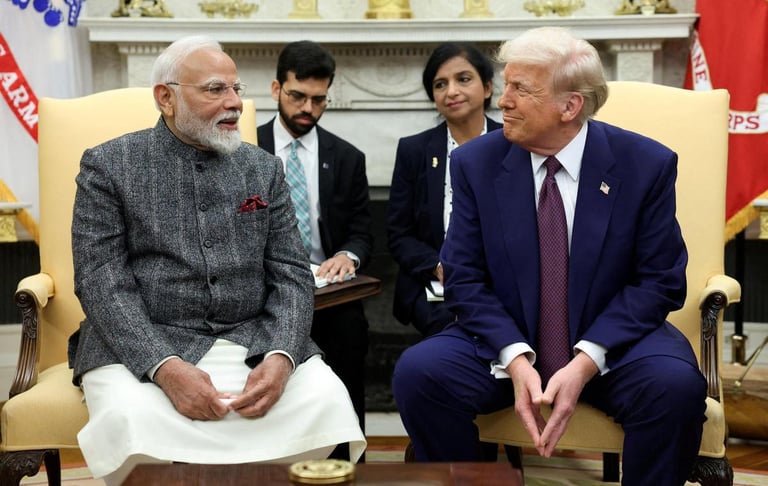
The order has become a flashpoint in U.S.–India relations because it conditions trade benefits — including the rollback of punitive tariffs — on New Delhi reducing or even halting its purchases of Russian crude.
Under the executive order, the United States agreed to drop a 25 % tariff previously imposed on Indian goods — part of Trump’s broader trade effort — but only if India significantly scales back its Russian oil imports. It also sets up a monitoring mechanism that could reimpose tariffs if India resumes direct or indirect purchases of Russian oil.
This framework is part of a broader interim trade pact that aims to lay the foundations for a full bilateral trade agreement between the world’s fifth and third largest economies. India has indicated it will maintain a multi-supplier energy strategy and preserve its strategic autonomy in energy sourcing.
How Much Has India Cut Its Russian Crude Imports?
Data shows that India’s actual imports of Russian crude oil have already declined sharply:
India imported around 2.09 million barrels per day (bpd) of Russian oil at its peak in mid-2025.
According to recent figures, imports declined to approximately 1.16 million bpd in January 2026.
Industry analysts and market trackers suggest that imports could nearly halve if India follows through more completely on commitments linked to the U.S. trade deal. Some estimates put future Russian crude imports around 400,000–500,000 bpd once winding down of contracts and deliveries is complete.
However, that transition is neither instantaneous nor uniform. Oil deliveries already booked are still being honored, and companies with long-term contracts — particularly Nayara Energy (backed by Rosneft) — may continue to receive Russian crude under existing agreements unless specific exemptions or new arrangements are negotiated.
Why Did Indian Imports Rise in the First Place?
India’s surge in Russian oil imports was not arbitrary. After Western sanctions on Moscow due to the Ukraine war, Russian crude began trading at significant discounts relative to other grades on global markets — often $8–$10 or more below Brent and Middle Eastern benchmarks in prior years. This made Russian heavy/sour crude economically attractive to Indian refiners.
Before the Ukraine invasion, Russian oil was a negligible share of India’s crude basket. But by 2024–25, it surged to around 35 % or more of total imports.
India’s Strategic Autonomy vs. U.S. Pressure
New Delhi has repeatedly emphasized that its energy sourcing is a matter of national interest and energy security, asserting that it follows market logic and long-term contracts rather than political dictates. The foreign ministry has underscored that any shift in sourcing will be pragmatic and gradual.
Unlike European buyers constrained by stringent sanctions regimes, India has maintained that its import patterns are compliant with international law. Nevertheless, the executive order’s monitoring clause reflects Washington’s intention to closely track New Delhi’s energy trade flows.
What Alternatives Does India Have?
If Indian refiners reduce Russian crude purchases, several alternative suppliers are in play:
Middle Eastern producers (Saudi Arabia, Iraq, Kuwait) remain traditional suppliers and can offer crude compatible with India’s refining configurations.
United States and Venezuela: Under the trade framework, India might increase imports of U.S. crude and LPG, though cost and technical suitability (especially for heavy Venezuelan crudes) vary.
Experts say switching sources is feasible because many Indian refineries are configured to process a range of crude grades — though refinery margins and costs could be affected if replacements are systematically more expensive or logistically complex.
The Broader U.S.–India Trade Framework
The drop in punitive tariffs is part of a broader interim trade framework aimed at deepening economic ties between the U.S. and India:
Tariffs on Indian goods into the U.S. will be reduced to around 18 % from the earlier 25 % baseline, contingent on the energy commitments.
India has pledged to purchase up to $500 billion in U.S. goods over the next five years, spanning energy, technology, agriculture, and industrial sectors.
The framework also involves mutual cooperation on export controls and standards recognition while safeguarding sensitive agricultural and industrial sectors on both sides.
Critics in India warn that the terms may favor U.S. interests disproportionately, particularly if India opens its market further without equivalent access for Indian exporters.
What’s Next?
India’s import of Russian crude oil is very likely to drop substantially — potentially by half or more — if the commitments under the U.S. trade deal are fully implemented. But this will unfold over months, not weeks, due to existing contracts, delivery pipelines, and refinery logistics.
At the same time, India will continue managing a multi-supplier energy strategy, balancing geopolitical pressures with economic and strategic energy needs. New Delhi’s precise steps will reflect that balancing act, especially as it navigates relations with both Moscow and Washington in a volatile global energy environment.
In short: Yes, India’s Russian oil imports are on a downward trajectory, with the potential for a significant drop, but the pace and scale will be shaped by commercial realities, existing contracts, and geopolitical strategy — not just the executive order alone.

Recommended Reads:
Follow us
DISCLAIMER
© 2025 Defence Insider. All rights reserved.