
Union Budget 2026–27: Key Announcements Shaping India’s Economic Future
INDIAN DEFENCE
The Union Budget 2026–27 marks a defining moment in India’s economic journey as the government seeks to balance growth ambitions with fiscal discipline in an increasingly uncertain global environment.
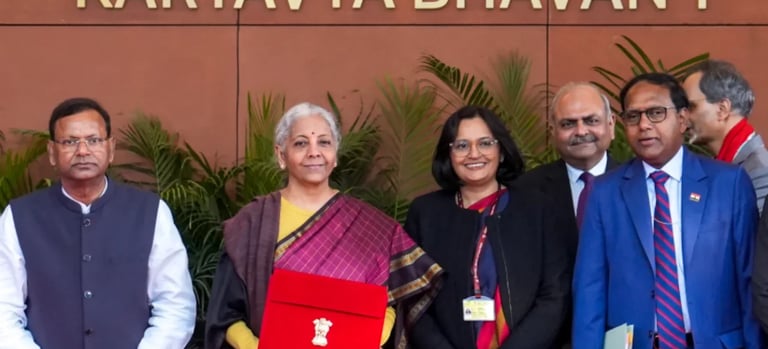
Presented at a time when geopolitical tensions, technological disruption, and climate challenges are reshaping economies worldwide, this budget reflects India’s intent to strengthen its domestic foundations while positioning itself as a resilient global player.
Rather than relying on short-term populism, the Budget 2026–27 emphasizes long-term structural reforms, capital investment, and inclusive growth. From infrastructure and manufacturing to digital innovation and defence preparedness, the budget outlines a comprehensive roadmap for sustainable economic expansion.
Focus on Economic Stability and Fiscal Prudence
One of the most notable aspects of the Union Budget 2026–27 is the government’s commitment to fiscal consolidation without compromising developmental priorities. The fiscal deficit target has been carefully calibrated to ensure macroeconomic stability while continuing public investment as a growth driver. This signals confidence in India’s economic fundamentals and reassures global investors of the country’s disciplined fiscal approach.
The government has reiterated its intention to gradually reduce public debt while maintaining sufficient liquidity to support growth. This balanced strategy reflects a mature economic outlook, recognizing that long-term credibility is as important as short-term stimulus.
Infrastructure as the Engine of Growth
Infrastructure development remains a cornerstone of the budget’s growth strategy. Substantial allocations have been made for roads, railways, ports, and logistics infrastructure, with a clear emphasis on enhancing connectivity and reducing transaction costs. The continued push for multimodal logistics parks and freight corridors is expected to improve supply chain efficiency and boost industrial productivity.
Urban infrastructure has also received attention, with increased funding for smart cities, affordable housing, and urban mobility projects. These investments not only create employment but also improve quality of life, supporting India’s rapid urbanization in a sustainable manner.
Manufacturing, MSMEs, and Self-Reliance
The Union Budget 2026–27 strengthens India’s manufacturing ambitions under the broader vision of self-reliance. Production-linked incentive (PLI) schemes have been extended and refined to encourage domestic manufacturing in strategic sectors such as electronics, semiconductors, defence equipment, and clean energy.
Micro, Small, and Medium Enterprises (MSMEs), often described as the backbone of the Indian economy, have received targeted support through enhanced credit access, simplified compliance mechanisms, and digital integration initiatives. These measures aim to improve MSME competitiveness, formalization, and export potential, thereby expanding their role in job creation.
Defence and National Security Spending
In line with India’s evolving security challenges, the budget underscores the importance of defence preparedness and indigenous capability development. Increased capital expenditure for defence modernization reflects a shift toward long-term capability building rather than short-term procurement.
A significant portion of the defence allocation has been directed toward domestic defence manufacturing, research and development, and private sector participation. This not only strengthens national security but also stimulates high-value manufacturing, technological innovation, and skilled employment.
Digital Economy and Technology Push
Recognizing technology as a key driver of future growth, the Union Budget 2026–27 places strong emphasis on the digital economy. Investments in artificial intelligence, semiconductor research, cybersecurity, and digital public infrastructure highlight India’s ambition to become a global technology hub.
The expansion of digital governance platforms and data-driven public service delivery aims to improve efficiency, transparency, and citizen engagement. Support for startups and innovation ecosystems further reinforces India’s position as one of the world’s fastest-growing digital economies.
Agriculture and Rural Development
Agriculture continues to be a priority, with the budget focusing on productivity enhancement, climate resilience, and farmer income stability. Increased investment in irrigation, agri-infrastructure, and technology-driven solutions such as precision farming reflects a shift from subsidy-heavy approaches to sustainable agricultural growth.
Rural development programs have been strengthened to improve livelihoods, healthcare access, and education in rural areas. These initiatives are crucial for reducing regional disparities and ensuring that economic growth remains inclusive.
Human Capital: Education and Skill Development
The Union Budget 2026–27 recognizes that long-term economic growth depends on a skilled and healthy workforce. Allocations for education focus on digital learning, vocational training, and higher education reforms aligned with industry needs.
Skill development programs have been expanded to prepare youth for emerging sectors such as renewable energy, defence manufacturing, and advanced technologies. This focus on human capital ensures that India’s demographic advantage translates into productive economic outcomes.
Conclusion
The Union Budget 2026–27 presents a forward-looking vision for India’s economic future, combining fiscal responsibility with strategic investment. By prioritizing infrastructure, manufacturing, defence, technology, and human capital, the government has laid the groundwork for sustained growth in a complex global environment.
Rather than offering short-term fixes, the budget signals a commitment to long-term nation-building. Its success, however, will depend on effective implementation, policy continuity, and collaboration between the public and private sectors. If executed well, the Union Budget 2026–27 could play a pivotal role in shaping India’s trajectory as a resilient, self-reliant, and globally competitive economy.
Recommended Reads:
Follow us
DISCLAIMER
© 2025 Defence Insider. All rights reserved.